
Climate Change & Coastal Acidification
What is ocean acidification?
Ocean acidification (OA) describes the decreasing pH level of the ocean over an extended period, primarily due to the uptake of carbon dioxide (CO2) from the atmosphere (NOAA, 2024; Guinotte and Fabry, 2008; Doney et al., 2009).
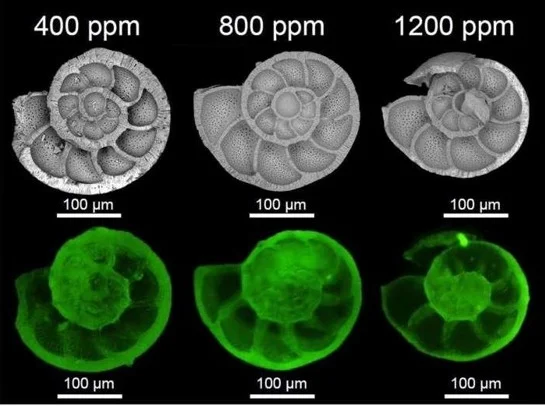
OA can affect the ability of calcifying marine organisms (e.g. hard corals, coccolithophores, sea urchins) to form and maintain their calcium carbonate-based structures, with severe cases of existing shells and skeletons being vulnerable to dissolution.
The negative effects of decreasing pH level extend to altered behavior of non-calcifying organisms, such as decreased predator detection and the inability to find proper habitat. On the other hand, favorable effects have been reported for some species of seaweed and seagrasses, utilizing the increased CO2 for photosynthesis (NOAA, 2024).
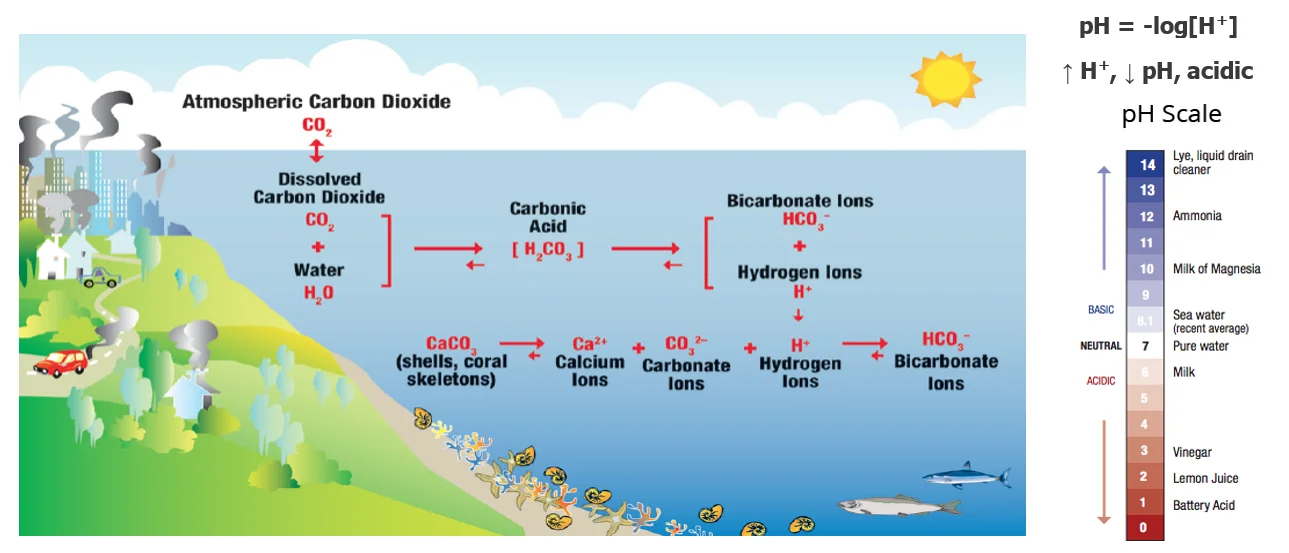
What is Coastal Acidification?
Coastal acidification refers to the decrease in pH and changes in the chemistry of coastal waters resulting from the combination of atmospheric CO2 uptake and local factors, such as nutrient-rich freshwater runoffs (NOAA, 2024).
Excess nutrients can facilitate an increase in algal growth, resulting in Harmful Algal Bloom events (NOAA, 2024; Wallace et al., 2014).
The coastal acidification is influenced by natural (e.g., aerobic respiration) and anthropogenic (e.g., combustion of fossil fuels, eutrophication) processes (Pettay et al., 2020).
How are we affected
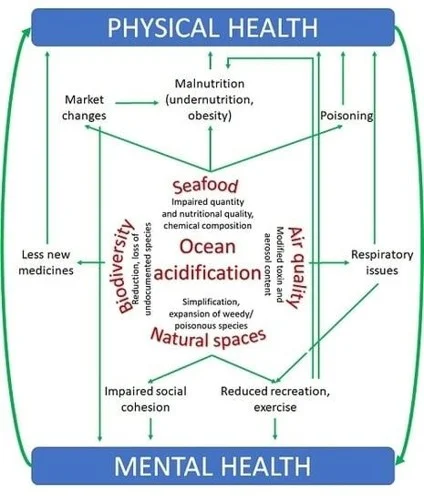
The effects of OA in humans can be viewed in physical and mental health aspects (Falkenberg et al., 2020).
The serious threat of OA to habitat maintenance, food supply, tourism, and coastal protection merits more research as it puts the coastal environment at risk, affecting ocean health and billions of people highly dependent on the marine environment to thrive.
The decline of coral reef health is affecting fish production, coastal reef integrity, and the tourism economy, among others (NOAA, 2024). Ocean acidification can also cause public health issues as it favors the occurrence of toxic HAB, which contaminates several economically important species (NOAA, 2024).
The destruction of shallow marine habitat and economic losses due to the impact of OC can affect the mental health of the local community, as the provision and regulating services are diminished by the changes in their local marine habitat.
The Philippine Context
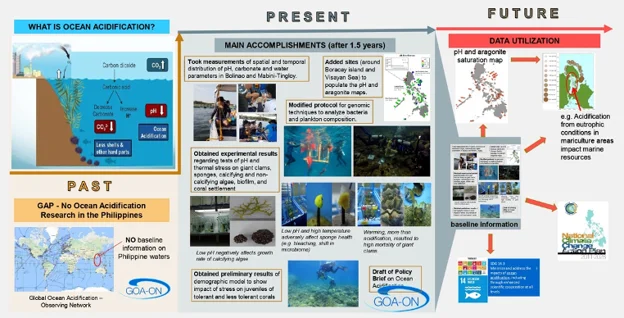
Studies on OA in the Philippines are new and limited. The Coastal Acidification Program (2018 – 2021), funded by the Department of Science and Technology – Philippine Council for Agriculture, Aquatic, and Natural Resources Research and Development (DOST – PCAARRD) is the first ocean acidification program of the country.
The program aims to understand the effect of coastal acidification on corals and other marine organisms. The program collected samples on 63 sites across the country to generate maps of carbonate chemistry parameters, such as pH and aragonite saturation state (ΩArag), serving as the baseline data for future ocean acidification research in the country.
A site-specific OA study was also conducted by Isah et al. (2022), reporting a localized acidification in the reef found in Bolinao, Pangasinan attributed to the decomposition/respiration of organic matter supplied by the unregulated fish mariculture activities.
In addition to localized acidification, the organic matter decomposition is also attributed as the cause of hypoxia in the area, and the interactive effect of the two environmental issues was also investigated (Ferrera et al. 2022, unpublished).
The work was extended to two major tourism sites within the province, namely Silaqui Giant Clam Ocean Nursery and The Hundred Islands National Park) (2023, unpublished).
In 2024, The Ocean Foundation donated the Global Ocean Acidification Observing Network (GOA-ON) in a box kit to support the Philippines effort in establishing infrastructures that will enable the autonomous monitoring of carbonate chemistry parameters for ocean acidification research.
All the concerned datasets are aimed to be submitted to the SDG 14.3.1 data indicator (pH) portal for use by the United Nations.
References
- National Oceanic and Atmospheric Administration (2024)”What is Ocean and Coastal acidification”. Retrieved from https://oceanservice.noaa.gov/facts/acidification.html
- National Oceanic and Atmospheric Administration (2024) https://www.noaa.gov/education/resource-collections/ocean-coasts/ocean-acidification
- Doney, S. C., Fabry, V. J., Feely, R. A., & Kleypas, J. A. (2009). Ocean acidification: the other CO2 problem. Annual review of marine science, 1, 169-192.
- Shuaishuai Dong et al (2023). Geoscience Frontiers. DOI: 10.1016/j.gsf.2023.101622
- Guinotte, J. M., & Fabry, V. J. (2008). Ocean acidification and its potential effects on marine ecosystems. Annals of the New York Academy of Sciences, 1134(1), 320-342.
- NorthEast Coastal Acidification Network. http://www.necan.org/overview
- National Oceanic and Atmospheric Administration (2024) ”What is Ocean and Coastal acidification”. Retrieved from https://oceanservice.noaa.gov/facts/acidification.html
- Pettay, D. T., Gonski, S. F., Cai, W. J., Sommerfield, C. K., & Ullman, W. J. (2020). The ebb and flow of protons: A novel approach for the assessment of estuarine and coastal acidification. Estuarine, Coastal and Shelf Science, 236, 106627.
- NorthEast Coastal Acidification Network. http://www.necan.org/overview
- Wallace, R. B., Baumann, H., Grear, J. S., Aller, R. C., & Gobler, C. J. (2014). Coastal ocean acidification: The other eutrophication problem. Estuarine, Coastal and Shelf Science, 148, 1-13.
- Pettay, D. T., Gonski, S. F., Cai, W. J., Sommerfield, C. K., & Ullman, W. J. (2020). The ebb and flow of protons: A novel approach for the assessment of estuarine and coastal acidification. Estuarine, Coastal and Shelf Science, 236, 106627.
- Wallace, R. B., Baumann, H., Grear, J. S., Aller, R. C., & Gobler, C. J. (2014). Coastal ocean acidification: The other eutrophication problem. Estuarine, Coastal and Shelf Science, 148, 1-13.
- Falkenberg et al., 2020. DOI: 10.3390/ijerph17124563
- https://www.fisheries.noaa.gov/insight/understanding-ocean-acidification
- https://ispweb.pcaarrd.dost.gov.ph/understanding-coastal-acidification-effects-to-corals-and-marine-organisms/
- Coastal Acidification Program: Dr. Ma. Lourdes SD McGlone, Dr. Aletta T. Yñiguez, Dr. Patrick C. Cabaitan/UPD MSI and Dr. Wilfredo Roehl Y. Licuanan/DLSU Isah et al., 2022.
- https://doi.org/10.3389/fmars.2022.858853